

How to Get the Best Value When Shopping for Rings Under $500 on The RealReal
Author: Danielle T.
Affiliation: Independent Research
Date: November 30, 2025
Introduction
If you've ever wandered The RealReal’s jewelry section wondering why two nearly identical rings are priced $150 apart, you’re definitely not alone. Many shoppers assume that metal type—10K vs. 14K vs. platinum—is the hidden lever behind price. But when you’re shopping under $500, that assumption can lead you straight past some of the best-value pieces on the site.
This study was created for the beauty- and budget-minded reader: anyone who loves sparkle, shops smart, and wants to understand what actually drives ring prices on The RealReal. With data-backed clarity, we break down how metal type, stone weight, and ring weight work together—so you can buy the prettiest ring at the smartest price.
Abstract
If you love luxury jewelry but not luxury prices, here’s some good news: the secrets to scoring the best ring deals under $500 on The RealReal are hiding in the data. After analyzing 107 rings, we found that nearly one-third of what determines the price comes down to just two things: weight and metal color—and not the metals you think.
Using statistical tests in Jamovi (Version 2.4), including Kruskal–Wallis and linear regression analysis, this study reveals that heft (grams) and stone carat weight are the real price drivers, while the difference between 14K, 18K, and platinum often feels bigger than it actually is. In fact, every extra gram of metal adds an average of $28.34 to the price—yes, heavier rings really do cost more, and this finding is highly significant (p < .001).
For savvy shoppers, this means one thing: prioritize design and stone size, not just the metal stamped inside the band.
Keywords: ring pricing, jewelry, RealReal©, carat weight, metal type, consumer value
Metal Color Trends
Yellow gold → cheapest overall (β = –158.07, p = .005)
Rose gold → slightly cheaper (β = –67.83, p = .015)
White gold & platinum → neutral to pricier
Best value metals under $500:Yellow gold and rose gold
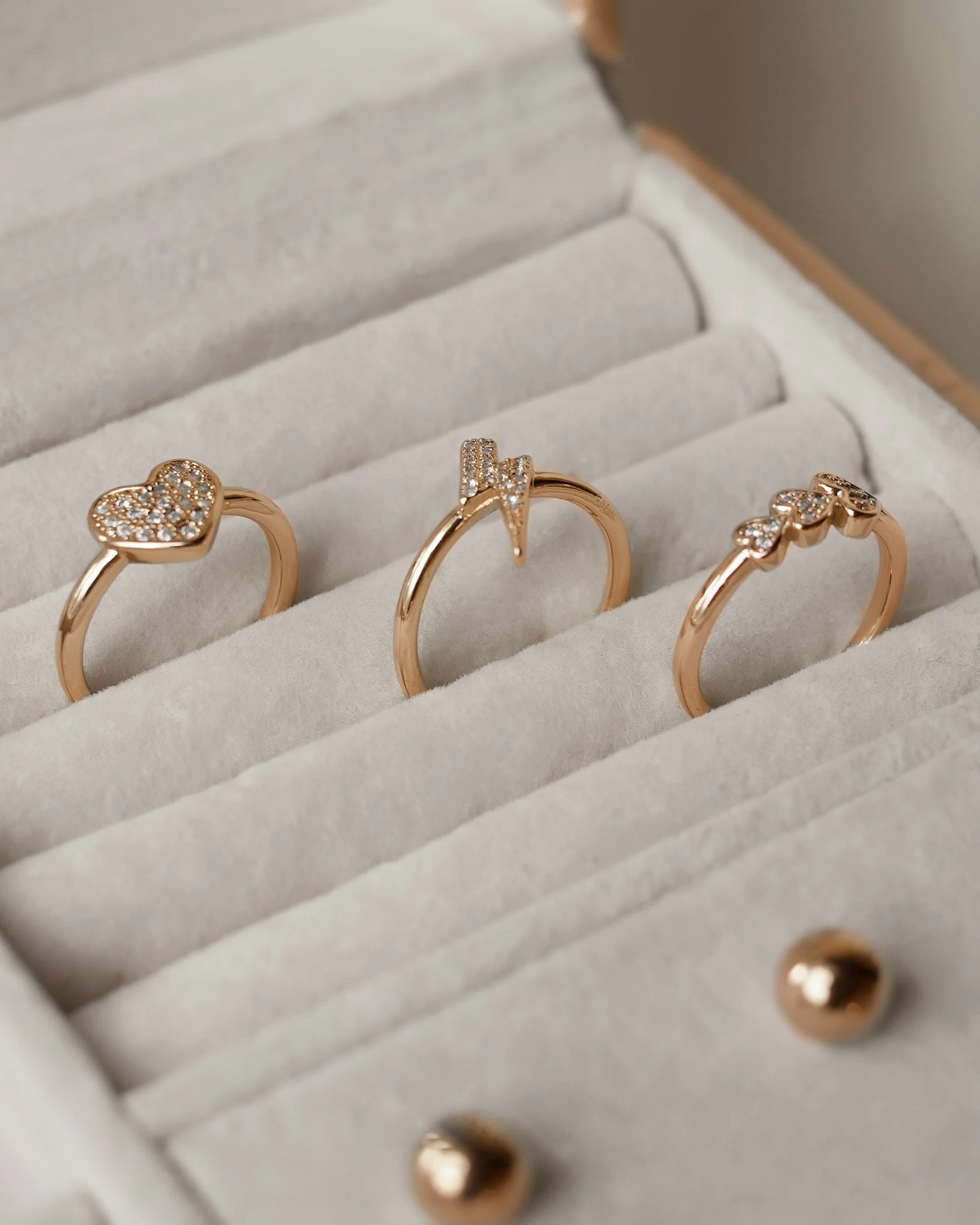
Three gold rings with pavé diamond designs, each ring is unique.
If sparkle is your priority, this is good news: find a big, clear stone and ignore tiny color differences.
Stone Characteristics
Heavier stones → higher price
Stone color → barely affects price
If sparkle is your priority, this is good news: find a big, clear stone and ignore tiny color differences.
Scrap Value Comparison
Even when comparing calculated scrap values:
Platinum costs most per gram
14K > 10K
18K fluctuates the most, so weight doesn’t predict price well on The RealReal
What Predicts Metal Type? (Omnibus Test)
Stone size was the strongest significant predictor:
Carat weight: χ²(3) = 11.65, p = .009
Other predictors were not statistically significant, including:
Total weight
Price
Scrap value
Discount percentage
Overall model: χ²(12) = 29.38, p = .003
Bigger stones tend to be set in certain metals.
But metal type doesn’t reliably predict price by itself.
Method
Data Collection
On November 30th, 2025, 107 rings priced under $500 were collected from The RealReal© for analysis. Variables included:
Dependent Variable (DV): Listing Price (USD)
Independent Variables (IVs):
Total Item Weight (g)
Carat Weight (ctw)
Metal Type
Metal Color
Stone Type
Stone Color
Statistical Analyses
Kruskal–Wallis test — compared average listing prices across five metal types.
Dunn’s post hoc test — identified which metals differed from each other.
Simple linear regression — measured how much weight predicts price.
Assumption checks — multicollinearity, residual normality.
Analyses were conducted using Jamovi 2.4 and R (4.1).
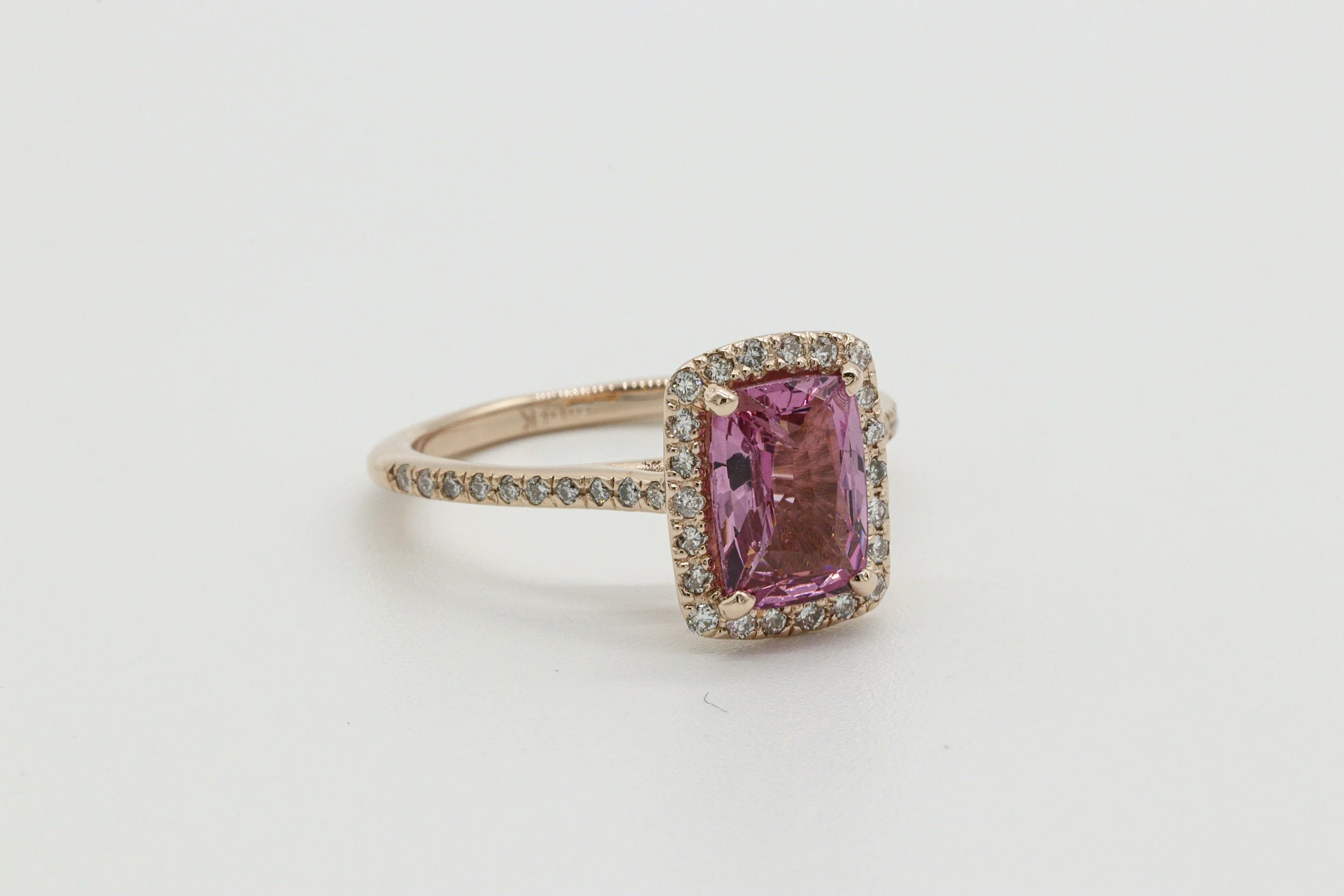
A pink sapphire gemstone in a rectangular cushion cut with a diamond stone halo set in a gold band.
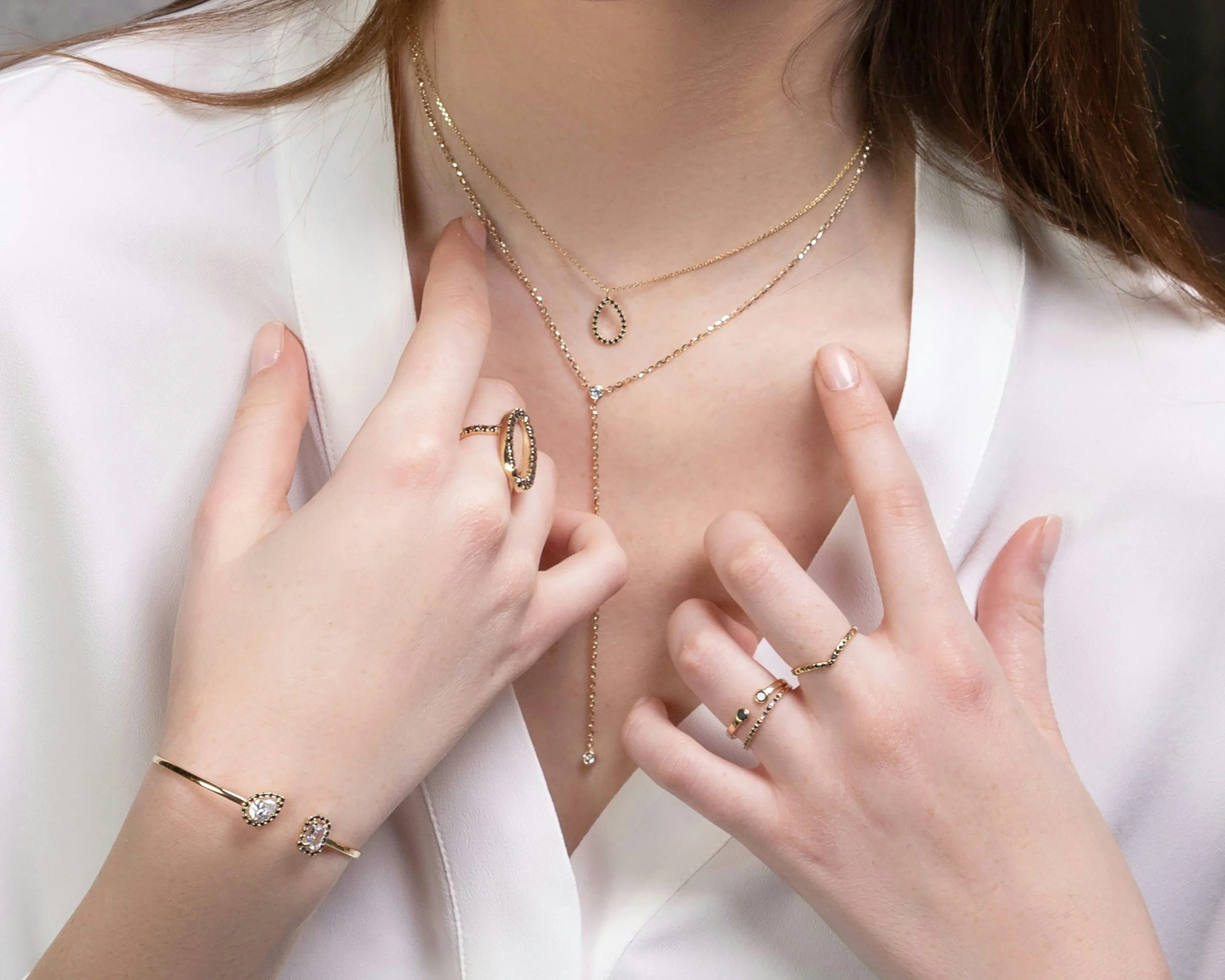
A woman wearing stackable gold rings and layered, thin-chained necklaces.
This data shows that the smartest shoppers look beyond the gold stamp and focus on the sparkle, the heft, and the design—because that’s what truly determines value.
Big takeaway:
Don’t overpay just for the metal. Style and stone matter more.
Discussion
So What Does All This Mean for You, the Shopper?
Here’s the real-world, wallet-friendly breakdown:
Focus on weight and carat size.
They’re the clearest predictors of price.Don’t obsess over metal type under $500.
The price differences aren’t big enough to pull significant data.Yellow and rose gold are your value metals.
They consistently appear at lower price points for similar styles.Want the “premium” feel?
Heavy rings are more likely to be platinum—but you’ll pay for that extra weight.
Under $500, platinum pieces are usually daintier because heavy platinum = expensive.
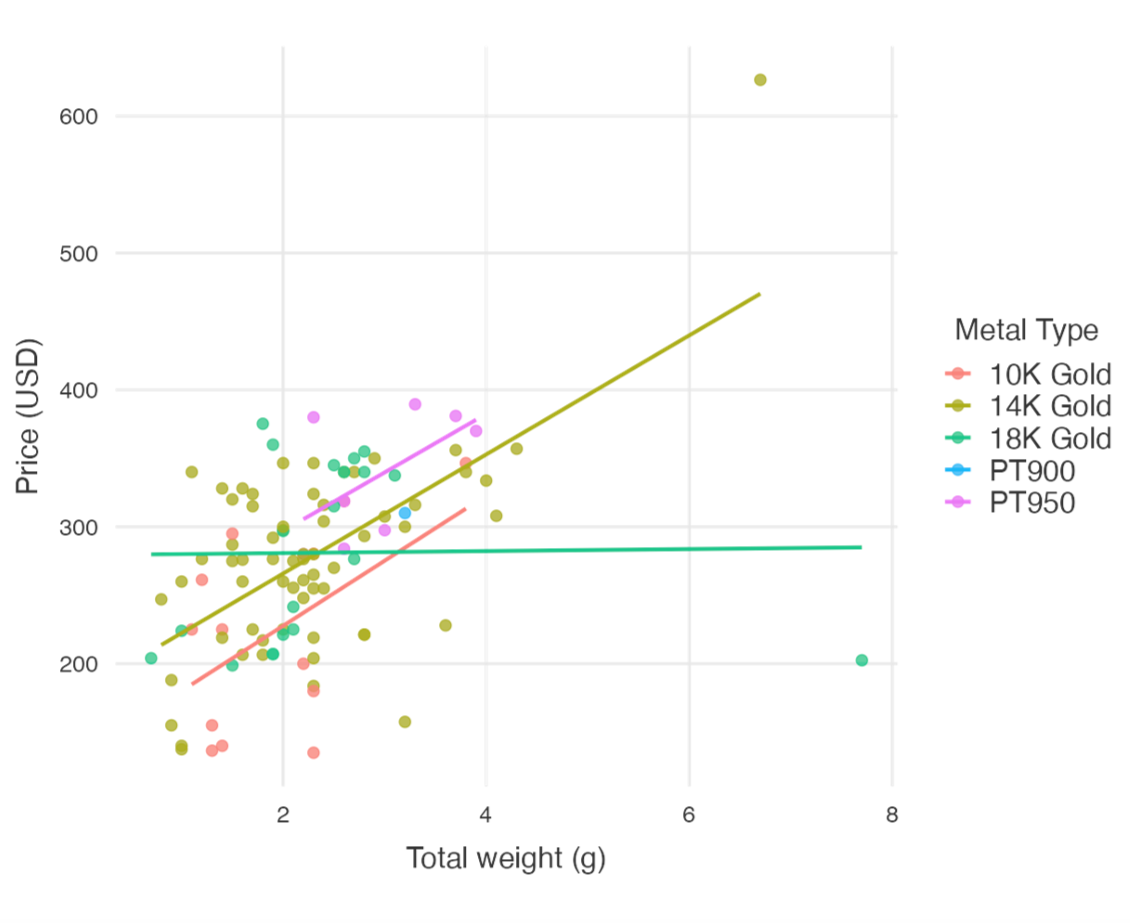
Figure 1. A scatterplot showing the slope directions of each metal type tested by the hypothesis that metal type was a significant contributor to price (USD) [1,4,5,6].
![Figure 2. A scatterplot showing the slope directions of each metal physical characteristic (yellow gold, white gold, rose gold, or platinum. This scatterplot identifies which metal types had a significant effect on the resale price in USD [1,4,5,6].](https://images.squarespace-cdn.com/content/v1/68d84156b85e847b93ee1f97/bcb39a41-2874-4ba3-ae0f-4fd1d845fe9a/Screenshot+2025-12-01+at+2.39.58%E2%80%AFPM.png)
Figure 2. A scatterplot showing the slope directions of each metal physical characteristic (yellow gold, white gold, rose gold, or platinum. This scatterplot identifies which metal types had a significant effect on the resale price in USD [1,4,5,6].
Results
Metal Type Matters… but Not as Much as People Think
The Kruskal–Wallis test revealed that average prices do vary across metal types:
χ²(4) = 13.9, p = .008, ε² = .132 (a small-to-moderate effect).
However, post hoc comparisons showed that the differences aren’t huge or consistent enough to make metal type your primary decision point.
Big takeaway: Don’t overpay just for the metal. Style and stone matter more.
Heavier Rings Cost More, Every Time
Linear regression results (Table 1 in PDF) showed weight is one of the strongest predictors of listing price:
Translation for shoppers:
Every extra gram adds about $28 to the price. Heavy rings = higher price, no surprise there.
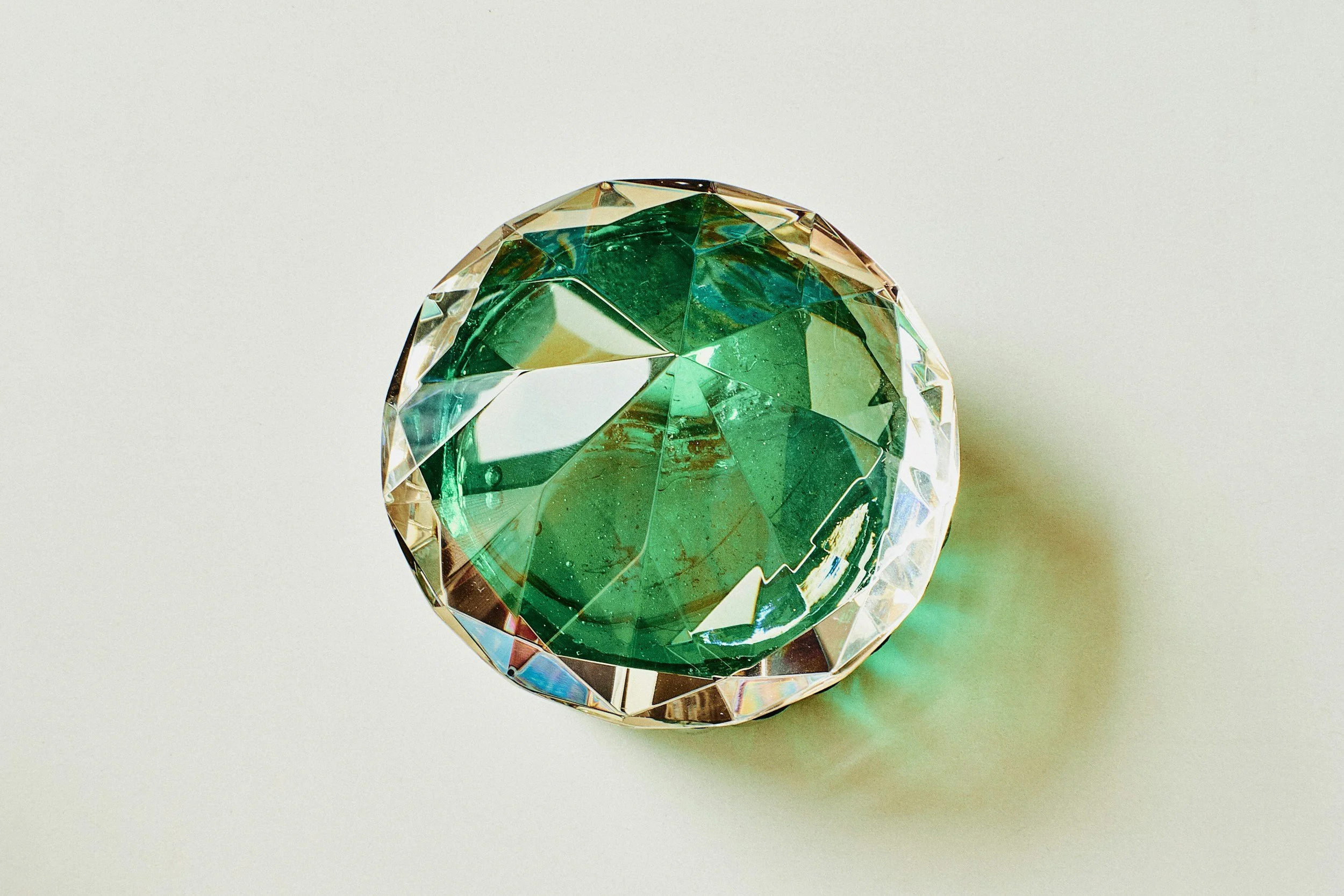
Emerald rings on The RealReal© were the best valued gem according to the study [4].
Conclusion
If you want the best deal on rings under $500 on The RealReal©, here’s the formula:'
Prioritize weight + stone size
Pick the metal you love aesthetically
Expect the highest value from yellow and rose gold (figure 2).
Don’t assume higher karat = higher price (figure 1).
This data shows that the smartest shoppers look beyond the gold stamp and focus on the sparkle, the heft, and the design—because that’s what truly determines value.

According to Aurevoir Les Filles (2025), croissant-style gold rings are making a strong comeback [2].
References
[1] Alloy Market. (2025). Platinum calculator. https://thealloymarket.com/calculators/platinum-calculator/
[2] Aurevoir Les Filles. (2025). The croissant ring: Design story & the rise of a modern classic.
https://aurevoirlesfilles.com/blogs/news/croissant-ring-hoops-story-design-process
[3] Fox, J., & Weisberg, S. (2020). car: Companion to applied regression [R package].
https://cran.r-project.org/package=car
[4] GoldCalc. (2025). Scrap gold value calculator. https://www.goldcalc.com/scrap_gold_value.php
[5] Jamovi Project. (2023). jamovi (Version 2.4) [Computer software]. https://www.jamovi.org
[6] R Core Team. (2022). R: A language and environment for statistical computing (Version 4.1)
[Computer software]. https://cran.r-project.org
[7] Ripley, B., & Venables, W. (2023). nnet: Feed-forward neural networks and multinomial log-linear models
[R package]. https://cran.r-project.org/package=nnet
[8] Rosseel, Y., et al. (2023). lavaan: Latent variable analysis [R package].
https://cran.r-project.org/package=lavaan
[9] Singmann, H. (2023). afex: Analysis of factorial experiments [R package].
https://cran.r-project.org/package=afex
[10] The RealReal. (2025). https://www.therealreal.com
